

In much of the contemporary West, the individual has become a cardinal value — in the strong sense: first principle, ultimate reference, moral horizon. « I owe it to myself », « I must fulfill myself », « I don't owe anyone anything »: these phrases circulate as self-evident truths. They are not always wrong. But when the individual becomes absolute sovereign, relational bonds suffer — sometimes in silence, sometimes in plain sight.
This article explores that shift: how cultural individualism shapes our expectations in love, friendship and work; what masks the self wears to protect itself; and why this phenomenon is especially striking in North Atlantic Western societies compared to other cultural traditions. A dedicated section draws on established research (Hofstede, World Values Survey, interdependence studies) — without caricature or essentialism.
Who it's for: anyone who feels « free » yet isolated, struggles to commit, or notices their relationships lack depth despite an obsessive quest for authenticity.
The cardinal individual: from autonomy to absolute sovereignty
Individualism, in the sociological sense, denotes a culture where a person's priorities, rights and identity take precedence over the group — extended family, community, hierarchy. It is not selfishness by definition: it is a value framework where everyone is expected to choose their path, express preferences and realize their potential.
The shift happens when autonomy becomes sovereignty without counterbalance: I must be myself, whatever happens to the bond. Couples, friendships and teams become services to consume — useful as long as they feed my wellbeing, disposable as soon as they demand effort. We no longer speak of compromise: we speak of « boundaries » and « protection » — sometimes fair words, sometimes a screen.
The signs are familiar: difficulty committing, fear of « losing » freedom, multiplying options (apps, networks, circles) without depth, discourse on authenticity that justifies leaving at the first discomfort. We want connection — but on conditions. The other must adapt without ever constraining.
This model is reinforced by an economy of attention and choice: everything is compared, rated, replaced. The cardinal self is not just an idea: it is an interface. And like any interface, it optimizes user experience — not always the relationship.
Understanding this mechanism does not mean giving up on yourself. It means recognizing that freedom refusing all mutual dependence often produces chosen solitude — and sometimes suffered solitude.
Four masks of the self: protected, authentic, rights, optimized
The protected self: « I won't open up, it's too risky. » After wounds, ghosting, disappointment, we build walls. Caution becomes the norm. We stay on the surface — messages, likes, dates without follow-up — because depth exposes. The paradox: the more we protect ourselves, the more we confirm the world is dangerous.
The authentic self: « I must be real, so I leave at the slightest misstep. » Authenticity becomes a performative injunction: the other must accept everything immediately, or it's « toxic ». We confuse authenticity with absence of relational effort. Saying what you think without listening to what the other person is experiencing is not authenticity — it's immaturity in disguise.
The rights self: « I know what I deserve. » Knowing your needs is essential. But when the list of rights has no mirror (my responsibilities toward the other), the relationship becomes an asymmetric contract. The other is judged on an invisible scorecard. One gap, and we « move on » — because we owe ourselves.
The optimized self: « I must become the best version of myself. » Personal development, productivity, quantified wellbeing. Connection is welcome only if it accelerates this project. The other becomes coach, audience or obstacle. Encounters are evaluated as investments — with expected emotional return.
These masks coexist. They all promise the same thing: preserving the cardinal self. They often cost the same thing: the ability to build something with someone who is not perfect — including yourself.
Dating, friendship, work: three testing grounds
In dating, cardinal individualism shows in fear of commitment and the illusion of infinite choice. We keep options open, avoid labels, leave before being left. Reciprocity becomes suspect: « If I show too much interest, I lose power. » Apps amplify this game — but the cultural backdrop makes it legitimate.
In friendship, the same logic turns close ones into emotional resources. We vent without giving back. We disappear when it gets demanding. Surface friendships — messages, stories — replace presence. We feel surrounded and alone at once.
At work, individualism appears as career-as-identity, permanent mobility, distrust of attachment to a team. Loyalty is seen as naivety. The collective suffers — and with it, sometimes, meaning.
On all three grounds, the remedy is not erasing the self. It is reintroducing connection as a value — not a constraint. Daring to stay when it's hard. Daring to leave when it's toxic. Telling the difference takes more than a slogan.
In-person meetings — coffee, a walk, a shared challenge — reintroduce salutary friction: the other is there, bodily. You cannot optimize everything. It's uncomfortable. That's often where something real begins.
Comparative study: why is the West so striking?
Geert Hofstede's work on cultural dimensions proposes an Individualism index (IDV) measured across hundreds of thousands of respondents. The chart below compares scores across several countries: Anglo-Saxon and Nordic nations sit at the very top, while many East Asian and sub-Saharan African societies rank markedly lower — with notable exceptions such as South Africa and India.
Approximate scores out of 100: the longer the bar, the more the culture values the individual over the group.
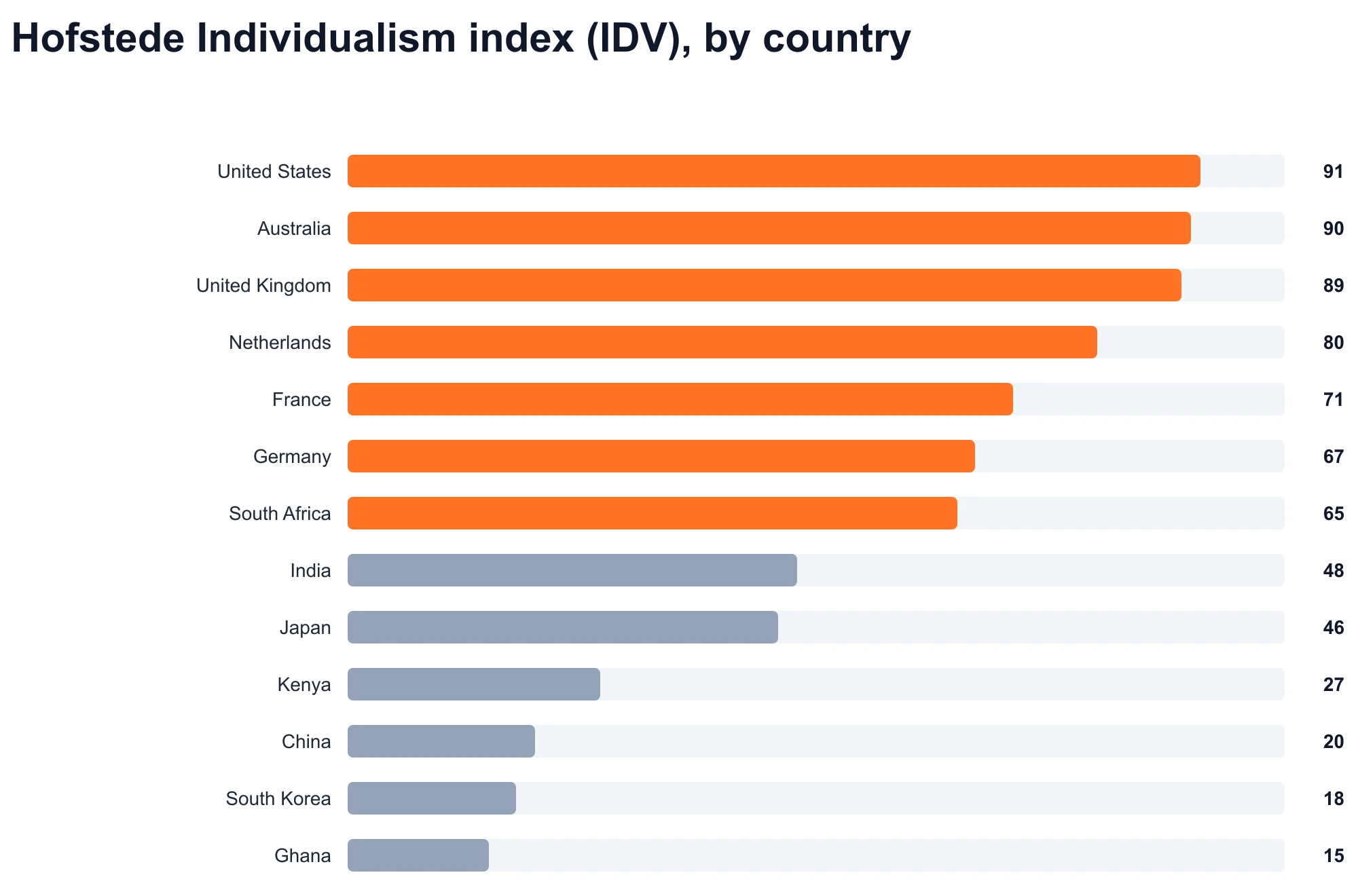
Source: Geert Hofstede, cultural dimensions (indicative values, national averages).
These figures do not mean « the East is collectivist and the West individualist » wholesale. They indicate statistical priorities: in high-IDV cultures, personal autonomy, individual recognition and the right to choose one's life are more often valued than group harmony. In low-IDV cultures, identity is more often defined by belonging — family, community, social role.
The World Values Survey (Inglehart & Welzel) complements this with the « survival vs self-expression » axis. Western European and North American societies have largely shifted toward autonomy, equality and participation values — sometimes at the cost of weakening traditional institutions (extended family, church, neighborhood). Research by Hazel Markus and Shinobu Kitayama distinguishes the independent self (typical of Western contexts) from the interdependent self (more common in East Asia): in the latter, respect, face and group harmony often structure relational behavior.
In Africa, the concept of ubuntu — « I am because we are » — expresses a vision of bond where the person exists through others. In Latin America, familismo blends urban modernity with strong family loyalty. These frameworks do not eliminate relational suffering; they offer cultural counterweights to the idea that the individual must always come first.
Globalization, urbanization and social networks partially homogenize these differences — a young Parisian and a young Seoulite may share the same dating fatigue. But structures of meaning persist: what counts as « normal » for commitment, sacrifice, speech or silence still varies widely. Recognizing these gaps helps explain why cardinal individualism hits the West so hard — and why exporting the model without nuance can isolate further.
Beyond the cardinal self: finding connection without giving yourself up
Escaping relational solitude does not mean returning to a society where the individual does not exist. It means another definition of freedom: one that includes the capacity to attach — without dissolving.
Some concrete paths: accept that connection sometimes slows you down; distinguish legitimate protection from systematic flight; practice reciprocity (give as much as you receive); name what you feel rather than « testing » the other through silence; choose contexts where presence is hard to avoid.
That is Daremeet's spirit: creating real meeting situations — a place, an activity, a frame — where you cannot control everything from your screen. Not to abolish individualism, but to give it a human face again.
Authenticity matures over time. It is built with someone — not in a monologue about oneself. The cardinal self can learn to become a connected self: sovereign in choices, but no longer alone in existence.
If this article resonates, the first step may not be a grand theory. It is a simple meeting — and the decision not to flee at the first discomfort.
Nuances, counter-examples and what not to oversimplify
Western individualism also enabled major advances: civil rights, gender equality, recognition of orientations and identities, protection against family abuse. Talking about the excesses of individualism must never justify a return to oppression.
High-IDV countries are not uniform: the Nordic model combines individual autonomy with strong social solidarity; the United States mixes expressive individualism with community traditions (churches, associations, sport). Africa and Asia are not monoliths: 54 African states, hyper-connected megacities, diasporas recomposing values.
Finally, contemporary solitude has more than one cause: housing costs, precarity, screens, anonymous urbanization, pandemics. Cardinal individualism is a factor — not the only one.
Conclusion: freedom and connection are not opposites
When the individual becomes cardinal — absolute, sovereign, owing nothing to the other — relational bonds thin. This phenomenon is especially visible in part of the West, where centuries of valuing personal autonomy and digital tools of infinite choice converge.
Recognizing the masks of the self (protected, authentic, rights, optimized) helps see what plays out in dating, friendship and work — without guilt-tripping every need for boundaries.
Cultural comparison reminds us there are other ways of being oneself with others. The challenge, for those living in highly individualist societies, is to reinvent chosen connection — not suffered connection. That may be where authentic encounters begin.
Ready to step out of the cardinal self, in real life?
Download Daremeet, pick a challenge and a place, and create moments where the other's presence matters as much as your authenticity.
Find more investigations and analyses on the Daremeet Blog.